

 by Joshua Olson-Kerrigan on

Table of contents
This year I'm spending my personal development budget on Thai lessons, therapy, and a scooter safety course. I'm not sure all three of those would have passed the old version of our Personal Development policy, which is kind of the point.
The budget that technically existed
We've had a €1,000 annual personal development budget for a while. For a while, most of it went unspent. Not because people didn't want to use it, but because the implicit expectation was that whatever you spent it on should be clearly, justifiably work-relevant. Nobody wrote that rule down anywhere. But it was there, quietly doing its job: keeping the definition narrow enough that most people talked themselves out of things before they'd even asked.
Team Up had been circling the question for a while. Expand it? Restructure it? There were good arguments for everything and against everything. In the end the answer was simpler than we'd been making it: loosen the guidelines and let people choose what they actually want to do with it.
We want our employees to develop meaningfully, so we increased the scope to reflect that. The main requirement stayed the same. It should be learning or education-based. We just dramatically expanded what counts as that.
So what counts now? (More than before, that's for sure)
Therapy. Fitness coaching. Yoga. Swimming lessons. Language courses. Creative workshops. Sports coaching. A scooter safety course, apparently. If it helps you learn something or take care of yourself, it probably qualifies. We also bumped the book budget to €50/month and included audiobooks, because it's 2026 and that's just how people read.
Does guitar count? (Yes.)
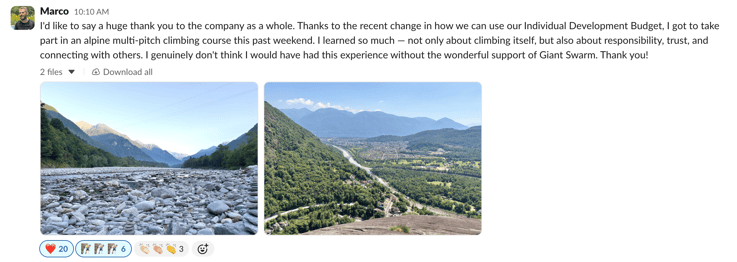
The reaction when we announced it was pretty immediate. Questions started coming in, not "how does this work?" questions, but "does this count?" questions. Guitar lessons. Therapy. Regular swimming classes. People had clearly been sitting on ideas for a while, and we were glad they finally felt like those ideas were on the table.
The bit where I make a broader point (briefly)
I think there's a broader point here, though I'll keep it brief because I don't think it's that complicated.
A lot of companies talk about employee wellbeing and then design benefits that are rigid, hard to access, and implicitly communicate that they don't quite trust people to make good decisions with them. I get why: legal reasons, budget constraints, the difficulty of one-size-fits-all solutions. But the reluctance to give employees actual choice in how they develop themselves does seem a bit archaic, given how much choice exists.
We're a fully remote company. We trust people to manage their own time, their own work, their own schedules. Trusting them to know what they need to keep growing didn't feel like a big leap. The main things were: it should still be learning or education-based, there's still a budget, and if you're not sure whether something counts just ask. Within reason. (ง •_•)ง
If someone reads this and the main thing they take away is that Giant Swarm is pragmatic about this stuff, that's the right read. We noticed something wasn't working, we changed it, we're watching how it goes. Thai lessons included.

.png)