

Cloud Native Developer Platforms
For over a decade, some of Europe's most demanding enterprises have trusted us to build and run their developer platforms. We handle the complexity in your environment, so your teams can focus on what matters.
Building at Speed
Your platform team guides technology choices while developers maintain velocity. We help implement company-specific standards that reflect your unique requirements, drawing on our experience of what works in production.

The Power of Golden Paths
We help your platform engineers design and implement golden paths that reflect your specific company standards, security requirements, and operational needs. Our experience guides the process, but the paths are uniquely yours. Developers can follow these proven patterns automatically, ensuring consistency across teams and projects.
More than Infrastructure
Without standardized paths, developers can spend weeks figuring out configuration and tooling choices. With golden paths, your platform team guides these decisions upfront, letting developers focus on building features. Every component — from Kubernetes clusters to observability, networking, and developer tooling — is pre-integrated according to your specifications.
More Than Infrastructure
Without standardized paths, developers can spend weeks figuring out configuration and tooling choices. With golden paths, your platform team guides these decisions upfront, letting developers focus on building features. Every component — from Kubernetes clusters to observability, networking, and developer tooling — is pre-integrated according to your specifications.

Why it Works
We've learned what enterprises need to deliver software successfully at scale: platform teams need effective ways to implement and maintain standards, while developers need clear paths to production. When teams choose tools and versions independently, maintaining and supporting these divergent choices becomes increasingly complex.
Learn more
Why It Works
We've learned what enterprises need to deliver software successfully at scale: platform teams need effective ways to implement and maintain standards, while developers need clear paths to production. When teams choose tools and versions independently, maintaining and supporting these divergent choices becomes increasingly complex.
Learn moreEnterprise Foundation
Our platform supports your platform team's mission to maintain production-grade infrastructure. We combine sophisticated multi-cluster management with battle-tested open source components to handle workloads at any scale.
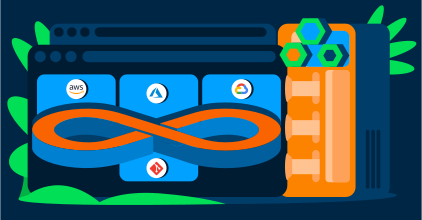
Technical Foundation That Scales
GitOps drives everything. Our cluster API manages workloads consistently across AWS, Azure, Google Cloud, and private cloud. The API-first architecture enables deep integration with your existing tools while maintaining complete control of your environment. Through our declarative approach and sophisticated fleet management, we help platform teams maintain consistency without sacrificing flexibility.
Built for Production
Security and observability are core platform features, not afterthoughts. Every component — from RBAC to audit trails — is configured based on real production experience. We run mission-critical infrastructure for some of Europe's largest enterprises, with integrated monitoring, multi-tenancy, and hybrid cloud support proven in the most demanding environments. Open source foundations ensure you maintain control of your destiny.
Built for Production
Security and observability are core platform features, not afterthoughts. Every component — from RBAC to audit trails — is configured based on real production experience. We run mission-critical infrastructure for some of Europe's largest enterprises, with integrated monitoring, multi-tenancy, and hybrid cloud support proven in the most demanding environments. Open source foundations ensure you maintain control of your destiny.

Complete Partnership
Platform engineering is a team sport. Our engineers work alongside your platform team as a seamless extension of your organization. This isn't about support tickets — it's about shared ownership of your platform's success through continuous collaboration and improvement. When you need us, you message our engineers directly in Slack. These are the same experts who build and run your platform. We handle everything from Day 1 operations through Day 2 complexity, delivering 99.9% uptime while your platform team focuses on strategic initiatives.
Frequently Asked Questions
What is an Internal Developer Platform (IDP), and why should you adopt one?
An Internal Developer Platform (IDP) is a curated self-service layer that empowers developers to deploy, operate, and manage applications without waiting on operations or wrestling with infrastructure.
It wraps reusable workflows, environments, and guardrails into a consistent experience — accelerating delivery and reducing errors.
Teams adopt IDPs to:
- Minimize cognitive load for developers
- Enforce security and governance without slowing teams down
- Standardize how software is shipped across environments
- Shorten the path from idea to production
Which features matter most in a strong IDP?
Not all platforms are created equal. The most effective Internal Developer Platforms offer:
- Golden paths for repeatable, secure deployments
- Git-based workflows (e.g. GitOps)
- Role-based access control (RBAC)
- Multi-cluster and multi-cloud support
- Secrets and identity management
- Built-in observability (logs, metrics, tracing)
- Declarative policy enforcement (e.g. OPA, Kyverno)
These capabilities give developers confidence, reduce manual toil, and ensure compliance is baked in from the start.
Should we build, buy, or adopt an open-source IDP?
It depends on your internal capabilities, appetite for ownership, and desired speed to value:
- Build: High flexibility, but long timelines and long-term maintenance.
- Buy: Fastest path to value, with support and reliability — but less customization.
- Open-source / hybrid: Combine a solid OSS foundation (e.g. Backstage, Argo CD) with commercial support or internal extensions.
Many teams start with open source or a commercial base and evolve into a hybrid model — shaping the platform to their needs over time.
How do we roll out an Internal Developer Platform effectively?
Start small and prove value fast. Here’s a phased approach:
- Choose a pilot team and work with them to define workflows
- Focus on a few high-leverage use cases (e.g. staging deployments, secrets management)
- Collect feedback, iterate, and refine — golden paths are made, not bought
- Scale gradually by onboarding more teams and expanding capabilities
Prioritize self-service, developer experience, and clear documentation at every step.
How do we measure success or ROI from an IDP?
Look for real signals of platform impact, including:
- Deployment frequency
- Lead time for changes
- Mean time to recovery (MTTR)
- Platform adoption across teams
- Reduction in support tickets or shadow infrastructure
- Developer satisfaction or NPS
A successful IDP doesn’t just reduce toil — it becomes the standard way teams deliver software.
Learn more in our Internal developer platforms guide for deeper insights and real-world examples.
Talk to our experts
Book your 1:1 with the members of our sales team or reach out to us using the contact form.